This trip is open to beginners with no previous bushwalking or navigation experience. However a minimum fitness level is required. Because we will be camping overnight, you need to be able to walk with a backpack containing your camping gear, food, some water and weighing around 12kg. The trip should be no problem for anyone that does regular exercise. By exercise I mean something that causes you to sweat and become out of breath. By regular I mean a couple of times per week.
To help you learn navigation skills, you will at times be walking through bush where there is only a rough, faint or sometimes no track. There are areas of scrub and a few steep hills. In some places the scrub is thick and difficult to walk through. There are 2 river crossings which involve steep descents into and out of a river gorge. The vegetation around the rivers is dense. There is the occasional rock scramble, for details on this please see the section on rock scrambling below. On the positive side the steep and difficult terrain is limited to only a few short steep sections. The difference between the highest elevation and lowest elevation on the walk is about 200m. Most of the country is open bushland that can be walked normally. There is steady climbing and descending. The ground is uneven and bushy most of the time. It is not a walk along a track, it is walking through the bush – literally! We will be stopping frequently to gain map reading and compass skills so there will be plenty of time to rest on the way. I estimate that we may be walking 4-6 hours per day with our packs. The trip should be no problem for anyone that does regular exercise. It is graded a moderate overnight walk.
Rock Scrambling
There are one or two places on this walk that involve some basic rock scrambling. The term “rock scrambling” refers to steep and rocky ground where ropes or other protection is not needed however you might be using both your hands and feet to climb or descend. Your hands and arms are not needed to support your weight in any way however you may use your hands for balance and added support to climb or descend. There are a couple of places on this walk where this technique is used. It is well within the capabilities of people unfamiliar with this sort of terrain.
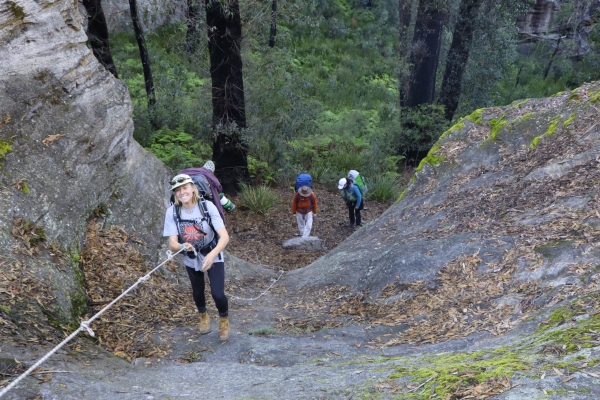
There is one short route used to exit and enter the camping area where a rope will be setup to allow you to climb and descend easily. Use of this route is entirely optional and an alternative route exists which does not require rope or rock scrambling. People of all ages and abilities have used this scrambling route successfully.
River Crossings
On both days we must cross the Wollangambe River. The crossing is at a different place on each day.
The width of the river at the crossing point is only about 2-3 metres. The depth of the river is below knee deep. The riverbed is comprised of smooth stones which may be slippery.
Crossing the river is simply a matter of wading for a few steps through water that is above your ankles but below your knees.
Typical hiking terrain, sometimes rocky
We will climb to a high ridge like this
This is an optional rock scramble
River crossing day 1 is on a log to avoid wet feet!
River crossing day 2
Still Unsure?
Don’t hesitate to write to me if you are unsure if the trip is suitable for you.
This trip is open to beginners with no previous bushwalking or navigation experience. However a minimum fitness level is required. Because we will be camping overnight, you need to be able to walk with a backpack containing your camping gear, food, some water and weighing around 12kg. The trip should be no problem for anyone that does regular exercise. By exercise I mean something that causes you to sweat and become out of breath. By regular I mean a couple of times per week.
To help you learn navigation skills, you will at times be walking through bush where there is only a rough, faint or sometimes no track. There are areas of scrub and a few steep hills. In some places the scrub is thick and difficult to walk through. There are 2 river crossings which involve steep descents into and out of a river gorge. The vegetation around the rivers is dense. There is the occasional rock scramble, for details on this please see the section on rock scrambling below. On the positive side the steep and difficult terrain is limited to only a few short steep sections. The difference between the highest elevation and lowest elevation on the walk is about 200m. Most of the country is open bushland that can be walked normally. There is steady climbing and descending. The ground is uneven and bushy most of the time. It is not a walk along a track, it is walking through the bush – literally! We will be stopping frequently to gain map reading and compass skills so there will be plenty of time to rest on the way. I estimate that we may be walking 4-6 hours per day with our packs. The trip should be no problem for anyone that does regular exercise. It is graded a moderate overnight walk.
Rock Scrambling
There are one or two places on this walk that involve some basic rock scrambling. The term “rock scrambling” refers to steep and rocky ground where ropes or other protection is not needed however you might be using both your hands and feet to climb or descend. Your hands and arms are not needed to support your weight in any way however you may use your hands for balance and added support to climb or descend. There are a couple of places on this walk where this technique is used. It is well within the capabilities of people unfamiliar with this sort of terrain.
There is one short route used to exit and enter the camping area where a rope will be setup to allow you to climb and descend easily. Use of this route is entirely optional and an alternative route exists which does not require rope or rock scrambling. People of all ages and abilities have used this scrambling route successfully.
River Crossings
On both days we must cross the Wollangambe River. The crossing is at a different place on each day.
The width of the river at the crossing point is only about 2-3 metres. The depth of the river is below knee deep. The riverbed is comprised of smooth stones which may be slippery.
Crossing the river is simply a matter of wading for a few steps through water that is above your ankles but below your knees.